
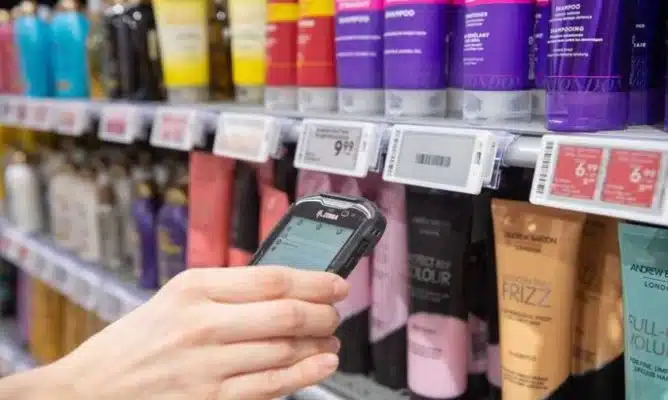
It’s not often that big corporations are seen as the good guys in a disagreement affecting shoppers. But in the debate over so-called surveillance pricing at the grocery store, some prominent critics of electronic shelf labels that many retailers are installing, are using questionable tactics to portray digital price tags as a bogeyman that it says most Americans believe should be banned.
The United Food and Commercial Workers International Union has released the results of a new poll it commissioned, to gauge shopper reaction to electronic shelf labels and the pricing shenanigans it says those digital tags can enable.
“Voters Say No To Digital Price Tags & Surveillance Pricing,” the UFCW announced in releasing its survey results. A national poll, it says, “shows overwhelming bipartisan support nationwide for banning surveillance pricing and electronic shelf labels (ESLs) in grocery stores.” 67% “support banning digital price tags and surveillance pricing.”
It’s not surprising that shoppers would express opposition to something scary like surveillance pricing. But are they really up in arms over the format of the shelf tags their stores use to tell them how much their groceries cost?
Note the careful placement of the word “and” in the UFCW’s statements – as in, shoppers oppose “digital price tags and surveillance pricing” – since some who have reported on their findings have not.
The actual question that the survey takers asked shoppers was “Congress is considering a proposal that would ban companies from using personal data like race, gender, or financial circumstances to set prices for individual consumers and require grocery stores to use paper price tags instead of digital price tags that can change prices instantly based on the time or day or weather. Do you support or oppose this proposal?”
So, based on the answers to that compound question, it’s technically accurate to say that 67% of shoppers oppose surveillance pricing “and” digital price tags. But it’s misleading if it’s meant to suggest that 67% are opposed to electronic shelf labels themselves.
What they do appear to be opposed to, is any use of these tools to adjust prices based on variables like shoppers’ personal attributes or transitory demand. The only question, then, is why 33% actually support that?
It could be because suppliers of electronic shelf labels, and retailers that use them, insist that lawmakers proposing legislation to ban digital price tags and personalized pricing could inadvertently be costing you more.
The UFCW supports such legislation, warning that “ESLs enable corporations to use AI and algorithms to set prices at a moment’s notice based on shoppers’ personal data, the weather, or a variety of factors.” But retailers say digital price tags are not used to display different prices to different shoppers – how could they? Shoppers who consent to sharing their personal data via loyalty programs can receive lower, personalized promotional prices that could be made illegal by some legislation under consideration. And the only time retailers say prices are likely to be changed “instantly” is when they need to put a product on clearance, instead of having to relabel it or move it to a different section of the store.
Otherwise, digital price tags are meant to be a cost-effective, labor-saving replacement for paper price tags that have to be printed up and swapped out every time there’s a price adjustment or a new weekly sale. Making these changes “instantly” saves staffers hours of work, and reduces any discrepancies between the price displayed at the shelf and charged at the register.
But the UFCW isn’t buying it. “Electronic shelf labels are a tool for price gouging Americans – full stop – and tech companies market it as such repeatedly,” UFCW International Vice President Ademola Oyefeso said in a statement. “Across the country, families are having to make tough choices in the grocery aisle every day as a result of sky-high prices, and polling clearly shows that they want these predatory technologies banned.”
The UFCW had previously released a survey with similar results, conducted solely in the state of Maryland, as it considered a first-in-the-nation surveillance pricing ban. That measure has since been signed into law, albeit in watered-down form, forbidding retailers from discriminating against any shopper by using their personal information to charge them higher prices.
There’s nothing in the new law, though, that blames the potential messenger by banning electronic shelf labels themselves. Several other versions introduced in other states and in the U.S. Congress propose just that, raising the prospect that retailers like Walmart and Kroger that have already installed digital price tags, will have to rip them all out and revert to paper shelf tags.
And that would be just fine with opponents like the UFCW. “Any lawmaker that is serious about cutting costs for hard-working families must support a ban on electronic shelf labels and surveillance pricing in grocery stores,” Oyefeso said.
There’s a legitimate debate to be had over whether to ban personalized pricing that goes too far – before it happens, instead of waiting until it becomes pervasive first. Banning digital price tags is one way to do it. But it will take another survey to find out whether that’s what 67% of shoppers really want.
Image source: Pricer













I dislike the digital price tags for the reason that almost all of them have smaller print on them than what was on the paper tags they replaced.