Some grocery shoppers buy store brands to save money, while others seek out specific store brands because they prefer them. Some grocery shoppers visit several stores to get all the best deals, while others visit several stores because they like each one’s unique products.
Our grocery shopping habits are changing, but it’s not only because of rising prices. And that’s led to the rise of the “barbell shopper.”
The commercial real estate company JLL highlights this phenomenon in its 2026 Grocery Tracker report. Considering it’s a company focused on real estate, JLL’s report concludes that grocery-anchored retail centers are a good investment. But the types of grocery stores that make for the best investments are changing, as our shopping habits evolve.
Citing data from Placer.ai, JLL noted that traditional supermarkets still earn the majority of grocery shoppers’ visits, but their share is declining. Over the past several years, foot traffic to traditional grocery chains has declined from more than 75% to just about 73%. “That might not sound dramatic,” JLL pointed out, “but in an industry this large, it represents billions of dollars in lost sales.”
The beneficiaries of this shift are traditional grocery stores’ higher- and lower-end alternatives. Visits to Kroger, the country’s largest traditional grocery chain, are essentially flat. But visits to ALDI are up more than 8%, as shoppers seek out savings. At the same time, though, visits to Whole Foods grew almost 10% – and shoppers aren’t necessarily going there for savings.
“On one end, high-income households are thriving, their wealth growing and fueling spending on premium, wellness-focused products,” JLL found. “On the other, middle- and lower-income families are feeling the squeeze, with drained savings and rising credit card debt forcing them to prioritize value above all else.”
The result is the “barbell shopper,” where growth in the industry is happening on the extremes – those who are saving and skimping are on one end, while those who are spending and splurging are on the other.
JLL cites the growth in store brands and the increasing frequency of grocery shopping trips as some of the clearest signals of this shift. Sales of private label products are surging among shoppers on both ends of the spectrum, as some shoppers trade down to save money, while others seek out specialty stores for proprietary brands they can’t get anywhere else.
That’s also contributed to an increase in shopping around. While some shoppers “are making smaller, targeted runs, often hitting multiple stores to cherry-pick deals,” JLL found that others are visiting more stores in order to splurge on the products they like there.
“The data confirms a two-track market where traditional supermarkets are being squeezed,” James Cook, Americas Director of Research, Retail at JLL, said in a statement. “We’re seeing a pronounced flight to value,” as visits to discount grocers rise, while at the same time, “fresh-format players are successfully capturing a dedicated consumer base” among those for whom value doesn’t automatically mean lower prices.
In the end, everyone has to eat. So no matter where you shop, or which end of the “barbell” you’re on, JLL concludes that the grocery industry as a whole is a healthy one. Circling back to its focus on real estate, JLL found that grocery-anchored retail centers have higher occupancy rates and are therefore better bets than non-grocery anchored centers.
So if you have any money left over after your next shopping trip – JLL just might have some investment ideas for you.
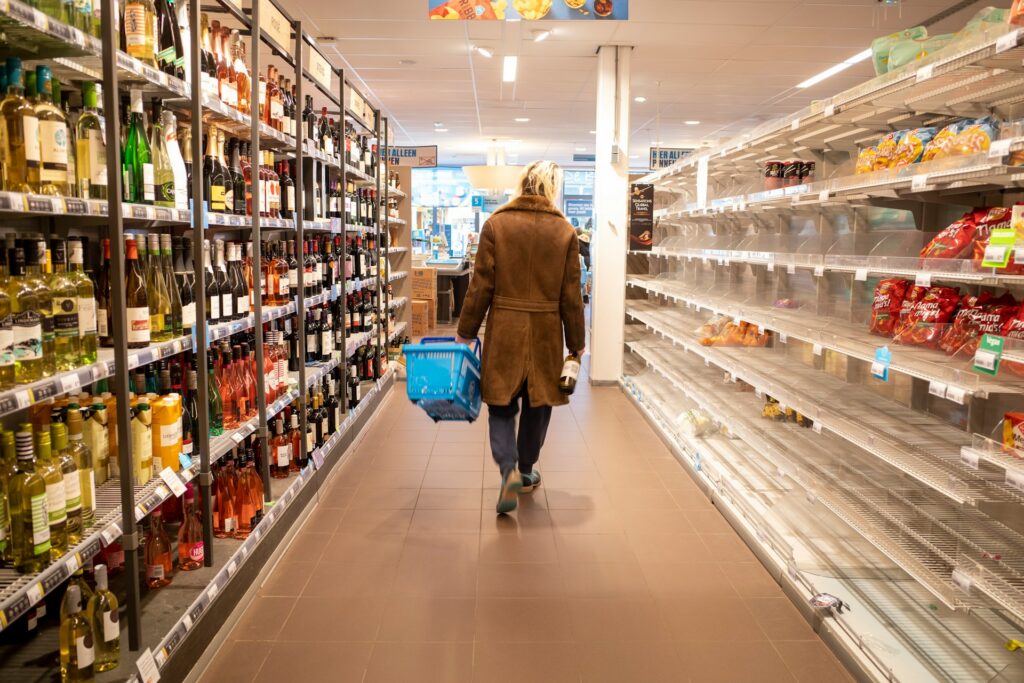
Image source: Martijn Baudoin on Unsplash