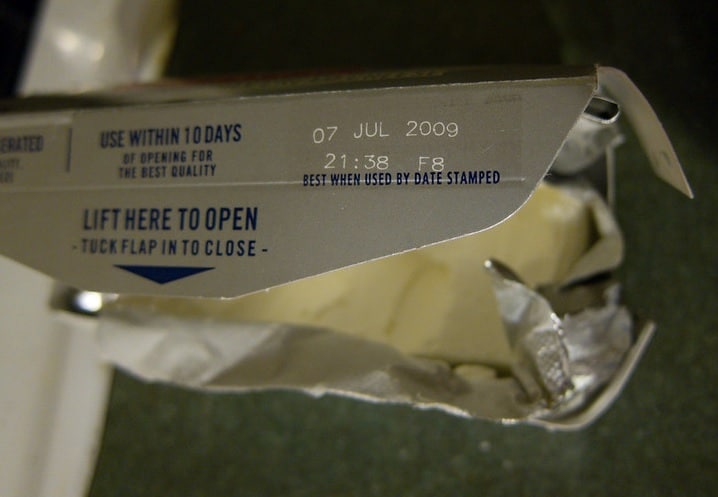
You work hard to clip coupons, scour the weekly grocery ads, and shop for the best deals to fill your fridge and pantry. And then one day you pull something out to see that it’s stamped with a date that has come and gone. So you toss it. Better safe than sorry, right?
Well, no matter what you paid for it, by throwing it out, you haven’t really saved any money at all. And if you weren’t sure whether that date stamp actually indicated the product was expired and unsafe to eat, that confusion could cost you.
One big state is about to do something about that. And another big state is now poised to join it. And together, they could have an impact nationwide.
California’s first-in-the-nation effort to streamline the way dates are described on food products, is set to take effect weeks from now, on July 1st. The bill was signed into law nearly two years ago, giving product manufacturers plenty of time to comply. Starting next month, phrases like “Sell By,” “Expires On,” “Freshest Before” and others like them will be outlawed. The only two phrases that can be used to describe a date stamped on a food product are “Use By” and “Best if Used By” – the first a warning, the second a suggestion.
And New York lawmakers thought it was such a good idea, they’ve now passed similar legislation of their own.
The Food Date Labeling Act has overwhelmingly passed both houses of the state legislature and is on its way to the governor’s desk for her potential signature. She has not indicated whether she intends to sign the bill, but with only nine of 198 lawmakers voting against it, supporters have more than a veto-proof majority necessary to push it over the finish line.
Like California’s law, New York’s version limits language for date labeling to “Use By” and “Best if Used by,” and will require manufacturers “to use scientifically valid methods” to back up the dates they use.
“If you’ve ever looked at a food date label and wondered what it means, you’re not alone,” the bill’s co-sponsor, Democratic state Senator Michelle Hinchey, said in a statement. “Confusing date labels lead people to throw away perfectly good food without even realizing it, wasting thousands of dollars per year and increasing emissions. The Food Date Labeling Act cuts through that confusion with clear, consistent labels that will help New Yorkers waste less and save more money.”
“The Food Date Labeling Act puts science and clarity where confusion used to be,” Democratic Assemblymember Karines Reyes, co-sponsor of the bill, added. As a result, “families can keep more food on the table, more money in their pockets, and more trust in what’s on their shelves. This is a victory for public health, household budgets, food security, and our environment.”
Consumer groups have long complained about confusing and inconsistent date labels that leave shoppers unable to tell when something is unsafe, when it’s merely past peak freshness, and when the date is just meant for internal use, like “sell by” dates that tell grocers when older stock should be rotated out.
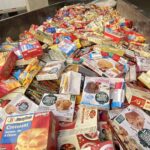
The effort to do something about it picked up steam when the issue transformed from an annoyance, to a food waste issue. The group Californians Against Waste estimated that residents in their state alone throw away six million tons of food each year, “and confusion over date labels is a leading cause,” they said. “By implementing this,” the New York bill states, “we can reduce food waste by approximately 20%, reduce methane emissions from landfilled food waste, and save consumers from unnecessary expedite on replacing food that is still completely edible.”
So far, efforts to address the issue have failed to gain traction on the national level, as legislation has languished in Congress. So states that are tired of waiting, are taking it upon themselves to act.
“For many years, federal food regulators have known that consumers are often confused by food date labels but have done nothing,” Ashley Ingram, Senior Associate Attorney for the Sustainable Food and Farming program at Earthjustice, said after New York’s bill passed. “We urge the Governor to sign this bill into law to join California and set a pioneering example for the federal government to follow.”
Supporters of New York’s bill say by reducing waste, the measure will help divert more food from landfills to food banks, where it can reach those in need. For everyone else, the bill will address a problem that is “financially costing American families $1,500 annually from food waste due to confusion from date labels.”
In this economy, an extra $1,500 can go a long way. With a second state now poised to mandate simpler date labels, manufacturers may decide it’s more efficient to use the same date phrasing everywhere. And then lawmakers will have succeeded in their aim to help you keep that $1,500 in your pocket – and out of the trash.
Image source: waitscm