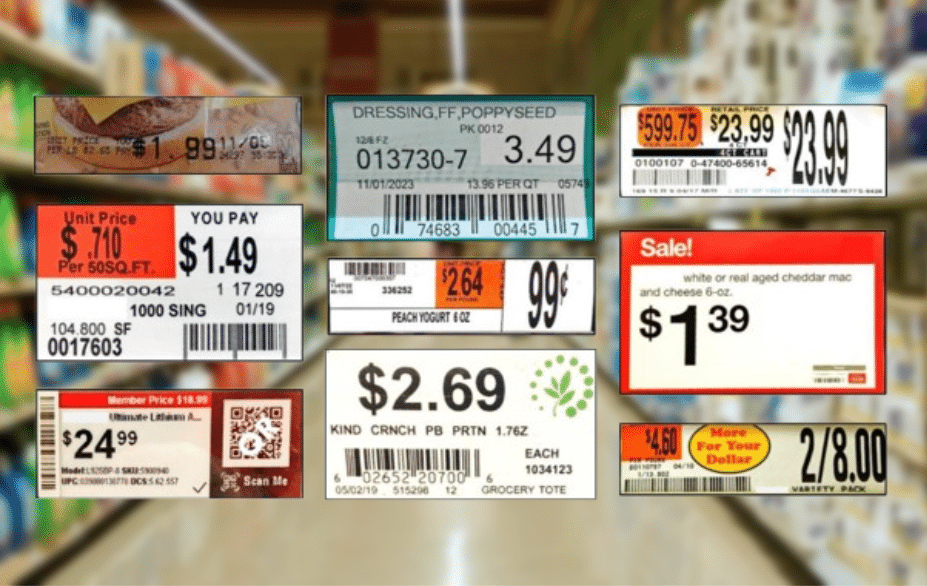
Few states actually require retailers to display the price-per-unit of grocery items. But even fewer have ever backtracked by repealing a unit pricing regulation – raising concerns that retailers are being given an open invitation to mislead and overcharge their own shoppers.
That’s what some are currently concerned about in Florida. Effective last month, the state no longer requires stores to show the price per ounce, or quart, or pound, or other unit, for items they sell.
A wide-ranging measure that took effect on July 1st orders, among other things, the repeal of Florida’s Consumer Unit Pricing Law, which has been on the books for decades. That law mandated that “a seller shall conspicuously and clearly display the price per package or unit and the unit price in close proximity to the display of the commodity,” which it said would “protect the interests of consumers and encourage constructive and useful competition in the sale of consumer commodities.”
No longer, however. A legislative summary of the measure passed by state lawmakers and signed by the governor mentions that it “makes a number of changes to laws related to the Department of Agriculture and Consumer Services” – including, on page 11 of the 111-page document, a terse provision repealing the unit pricing law. No explanation was given as to why the change was made.
One consumer advocate who knows a little more than most about unit pricing is sounding the alarm.
Tampa resident Vassilios Kukorinis reached two multimillion-dollar class-action settlements with Walmart in recent years, after accusing the retail giant of engaging in “unfair and deceptive business practices” with inaccurate, misleading and confusing unit price information on many of its grocery products. He’s now warning state and federal regulators about the consequences of the unit pricing law repeal.
The repeal “isn’t just deregulation – it’s a dream scenario for deceptive pricing,” he wrote in a letter to Florida’s Attorney General, the state’s Department of Agriculture and Consumer Services, and the Federal Trade Commission’s Bureau of Consumer Protection.
“I’ve continued to document widespread pricing discrepancies at Walmart stores across Florida and beyond,” he wrote, offering dozens of examples. The unit pricing repeal deprives consumers and state regulators “of the very yardstick that reveals these discrepancies,” he argued. “In effect, the legislature has handed every retailer an invisibility cloak: if the cost-per-ounce isn’t printed, there is no ‘error’ to cite, no violation to prosecute, and no trail for the shopper (or regulator) to follow.”
According to the U.S. Department of Commerce’s National Institute of Standards and Technology, only 15 states (Arkansas, Connecticut, Hawaii, Maryland, Massachusetts, Mississippi, Montana, Nevada, New Hampshire, New Jersey, New York, Oregon, Rhode Island, Vermont and West Virginia) and three territories (the District of Columbia, Puerto Rico and the Virgin Islands) currently have unit pricing laws or regulations in effect, which means “unit pricing is voluntary” everywhere else. But it strongly suggests that retailers voluntarily display unit prices, which “is one of the most effective tools available to consumers to facilitate value and price comparison.”
One of two major grocery chains based in Florida says it will continue to do so. “The repeal of Florida’s Consumer Unit Pricing Act will not affect the way we label or advertise our prices,” a spokesperson for Winn-Dixie owner Southeastern Grocers told Coupons in the News. “At Winn-Dixie, we remain dedicated to providing our customers with clear, transparent and accurate pricing information. Our commitment to offering quality items at affordable prices and exceptional value will continue to guide our practices.”
Florida’s other major grocery chain, Publix, did not respond to multiple requests for comment.
Publix itself is currently involved in litigation filed by a Florida shopper, who accuses the grocery chain of deceptive pricing via the use of inaccurate unit prices. Overcharges like the ones that shopper alleges, and the ones that Kukorinis says he’s seen at Walmart, will now “become harder to detect, because the benchmark information disappears,” he wrote of Florida’s unit pricing repeal. “Complaints will be harder to verify, because inspectors must now bring calculators – and time – the average shopper does not have. Bad actors gain a competitive edge, while honest grocers who still volunteer accurate unit pricing look artificially expensive.” In short, he argues, the repeal “transforms arithmetic ‘mistakes’ into a virtually risk-free revenue stream.”
He’s urging state and federal regulators to investigate the issue of “deceptive discount pricing,” in order to help protect consumers.
The National Institute of Standards and Technology suggests that retailers might want to stick with unit pricing in order to help themselves, too. “Unit pricing offers a means of customer service and satisfaction and improves the shopping experience,” the agency wrote in a recent report. “Greater transparency of pricing… can lead to higher levels of satisfaction, product evaluation certainty, and increased loyalty to stores.”
So if any retailer in Florida or the 34 other states that don’t require unit pricing is considering the state’s move to be an invitation to offer greater pricing opacity rather than greater pricing transparency, they might want to think again – for the good of their shoppers, and themselves.
Image sources: National Institute of Standards and Technology / joellevand