When Capital One agreed to settle a lawsuit accusing it of using its online coupon code finder to steal sales commissions from online influencers, the company insisted it was far from an admission of guilt.
Instead, it appears to have been a savvy legal move that proved Capital One’s point – and left its accusers with little to show for what they had hailed as “an excellent result.”
Several online content creators sued Capital One early last year, claiming that “tens of thousands” of people like them who promote products online, were losing money when shoppers clicked the Capital One Shopping browser extension looking for coupons. They claimed Capital One was hijacking the credit for referring the buyers, and therefore co-opting the sales commissions that the influencers claimed rightfully belonged to them.
Out of those “tens of thousands,” though, shockingly few influencers were able to prove their case. 18 of them, to be exact.
Last fall, Capital One agreed to settle the class action lawsuit, without admitting any fault. “Litigation is time-consuming, expensive, and distracting,” the company said in a statement to Coupons in the News. “Reaching a settlement allows Capital One Shopping to put this litigation behind the company so it can focus on its core mission of helping consumers save time and money and helping our advertising partners promote their goods and services.”
Under the terms of the settlement, any affected influencer could submit a claim for reimbursement if they believed Capital One Shopping hijacked any of their sales commissions. But there was one small catch – they had to prove it.
Any claimant had to show that one of their tracking codes showed up in Capital One’s data. That entitled them to a flat $20 payment, unless they could document exactly how much money they would have earned had it not been for Capital One.
Aside from “a few rare and isolated” cases, Capital One predicted few claimants would actually be owed anything, since “Capital One Shopping has not and does not overwrite cookies or steal commissions,” it insisted.
In newly-filed court documents, the plaintiffs revealed details about who claimed – and who earned – a payout. A total of 810 claims were filed. 792 of them were rejected, “because the filers failed to include the information needed.”
Three of the remaining 18 claimants were able to document specific losses they attributed to Capital One, and will be granted a combined total of $3,056.96. The other 15 will get 20 bucks each. So altogether, the class action turned out to be much ado about $3,356.96.
PayPal-owned Honey was the first online coupon code finder to come under fire from online content creators. A separate group is pursuing a class action lawsuit against PayPal, which continues to fight the allegations that it’s using the coupon finder to steal sales commissions. Other, similar, cases are ongoing against other coupon code finders, including RetailMeNot, Rakuten and Klarna.
So it may have seemed curious that Capital One chose to settle instead of fighting it out. But by choosing against fighting to win, it may have won anyway.
“Months of evidence collected in the litigation overwhelmingly confirmed that plaintiffs’ allegations were unfounded and that Capital One Shopping recognizes and follows industry rules,” Capital One asserted. But settling the case allows the company, its customers, and its accusers to move forward.
As part of the settlement agreement, Capital One did agree to pay up to $3.95 million to cover the plaintiffs’ attorney’s fees and expenses, and grant service awards of $10,000 to each of the five lead plaintiffs for their time and trouble in pursuing the case.
So by seeking to put this case behind it, Capital One will be out several million dollars. But in the end, distributing just $3,356.96 to prove its point that few accusers were wronged at all, may have been well worth the price.
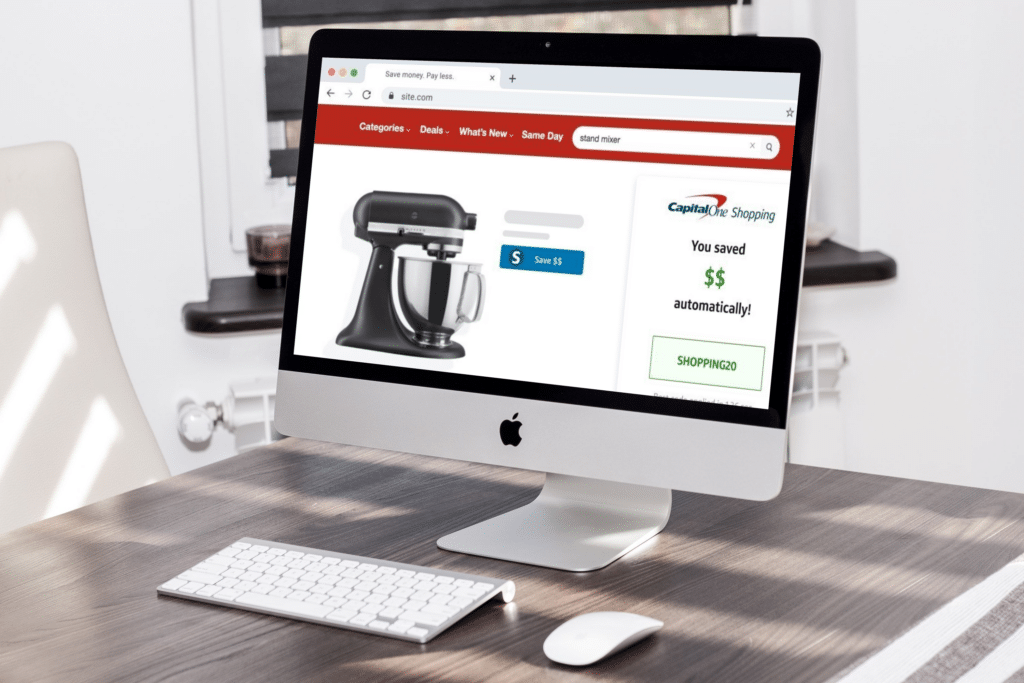
Image source: Capital One Shopping/Mockuper