
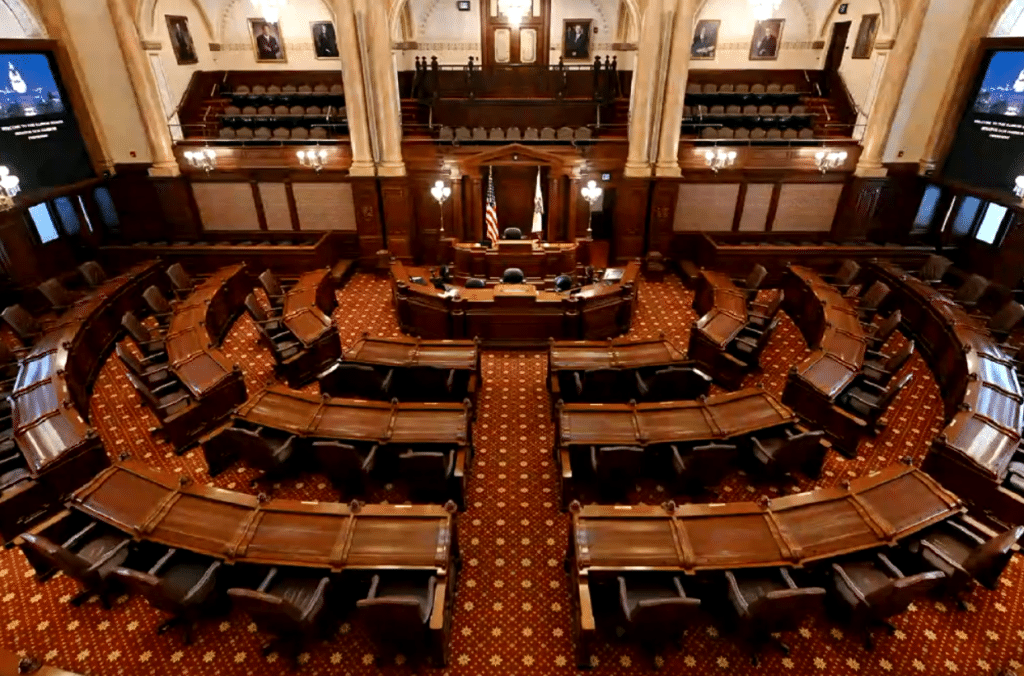
With zero exceptions, every one of Illinois’s state lawmakers have decided that requiring all stores to offer all digital coupons and deals to all shoppers is a good idea. All it will take now is for the governor to decide the same. Then, a much-debated proposal will officially become the first statewide law of its kind.
The Illinois Senate this afternoon unanimously passed a bill that would compel grocery chains offering digital-only promotions to make them available to all shoppers who may not have a digital device or digital access of their own. The House last month approved the same bill, also unanimously, which means the bill now heads to the governor’s desk.
When asked whether he supports or plans to sign the bill, Democratic Governor JB Pritzker’s office was noncommittal. “In the final days of this legislative session, the Governor’s Office will continue monitoring and carefully reviewing legislation as it moves through the General Assembly,” a spokesperson told Coupons in the News this afternoon.
But after passing unanimously in both legislative houses – the most veto-proof majority possible – it’s a safe bet that this measure is likely to soon become the law of the land.
Illinois’s measure is similar to, but more expansive than, a law that took effect last fall in San Diego, which was the first of its kind in any jurisdiction. San Diego’s ordinance took aim at advertised digital-only deals – the types you’d see on shelf tags and in store circulars, telling you what price you could pay if you clip a digital coupon or otherwise activate a digital deal online.
The goal was to ensure that seniors, low-income shoppers and anyone else without digital devices or the digital savviness to activate digital grocery deals, were not missing out on these advertised deals, which essentially amounted to false advertising to those without the means to access the prominently-featured low prices.
That’s what prompted several states over the past few years to introduce legislation to ban the practice, by requiring stores to offer alternative ways for the digitally-disconnected to access those low prices. San Diego was the first jurisdiction to push such a measure over the finish line. Illinois is now the first state to do the same.
But there are key differences between Illinois’s measure and San Diego’s. Illinois’s bill, originally introduced by Democratic state Representative Janet Yang Rohr, is not limited only to advertised digital deals. The bill “is in regard to digital coupons,” Democratic Sen. Laura Ellman, the bill’s co-sponsor, said on the Senate floor today. “If you use an app when you go grocery shopping to find those special savings, that’s great. But when people don’t use apps or they have difficulty with accessing electronics, this bill requires that a retailer provides some sort of way, and it’s up to their choosing, to allow for someone to take advantage of them.”
Ellman conceded that retailers can require a shopper to join their loyalty program if that’s a prerequisite for gaining access to the deals. But when asked earlier whether the bill was meant to apply only to advertised digital deals, her office told Coupons in the News last month that “the bill addresses all digital coupons” (emphasis added).
That’s a step even San Diego wouldn’t take. Aside from the few dozen digital deals featured in a weekly circular, many retailers offer hundreds of additional digital coupons – provided by individual manufacturers – that change by the day. Requiring stores to offer all digital coupon discounts to everyone, regardless of whether they clip the offers or even know they exist, could prompt the manufacturers offering those coupons to balk, ultimately causing more problems than it solves.
In San Diego, Albertsons-owned Vons eliminated most of its digital coupons for all shoppers, saying there was no other way it could comply with the ordinance as worded, even though its sponsors insisted it didn’t apply to all digital coupons. In Illinois, the bill’s sponsors insist their measure does apply to all digital coupons.
Retail organizations in Illinois have been curiously sanguine about it. When asked for reaction to today’s Senate vote, the Illinois Retail Merchants Association pointed to its earlier comment of support for the measure as drafted: “IRMA appreciates the collaborative work with Representative Yang Rohr on HB 45 to ensure consumers are able to receive discounts and benefit from affordability tools, while preserving the flexibility retailers need to serve their customers effectively.”
And when asked again whether it had any concerns or how it planned to comply, Albertsons – which effectively shut down its digital coupon program in San Diego, and which has nearly 200 Jewel-Osco stores throughout the state of Illinois – once again did not respond. The retailer may be keeping its powder dry and its options open, or it may just be willfully ignoring inquiries about very real concerns that could affect nearly every grocery shopper in the state of Illinois.
It’s been more than three years since the very first digital deal legislation was proposed on the statewide level. It took 16 long months for Illinois’s current measure to make its way through the House, and less than six weeks for it to sail through the Senate, just 11 days before the end of this year’s legislative session.
So the desire to level the playing field, by mandating more equal access to digital grocery deals, is clearly gaining momentum. As Illinois’s measure makes its way toward becoming law, and potentially lights a fire under other states that have considered similar legislation, the question will be whether it will solve a very real problem – or merely create new ones.
Image source: Illinois State Senate














What will this do to 8112?
These make no sense. Most coupons have NEVER automatically applied to everyone (the exception would be ones that were stuck to the packages that whoever was buying could have the checker take off).
Years ago, if you wanted them you had to buy a newspaper, cut them out and hand them in. Now, you have to set up an account and clip them.
Anyone can do either since the programs only require a phone NUMBER (not an actual phone that is portable and can be used online) and the option to use a computer (which are available to the public at spots like libraries if someone doesn’t have one).
That’s not true because you have to currently clip the coupon in the app. there are also other digital promotions that look like coupons in the app but aren’t. that’s what you are describing.
that’s what you are describing re giving your phone number, that is